Could a worldwide crowd repeat a historic astronomical experiment?
That was the scientific question. The app let people combine precisely timed observations from different locations to repeat the Transit of Venus method. Producing a scientifically new value for one astronomical unit was not the intended outcome.
Testing crowd science with smartphones
On 5 and 6 June 2012, Venus crossed the face of the Sun for the last time until 2117. For centuries, astronomers had used transits of Venus to calculate the astronomical unit: the distance between Earth and the Sun, and therefore the scale of the solar system.
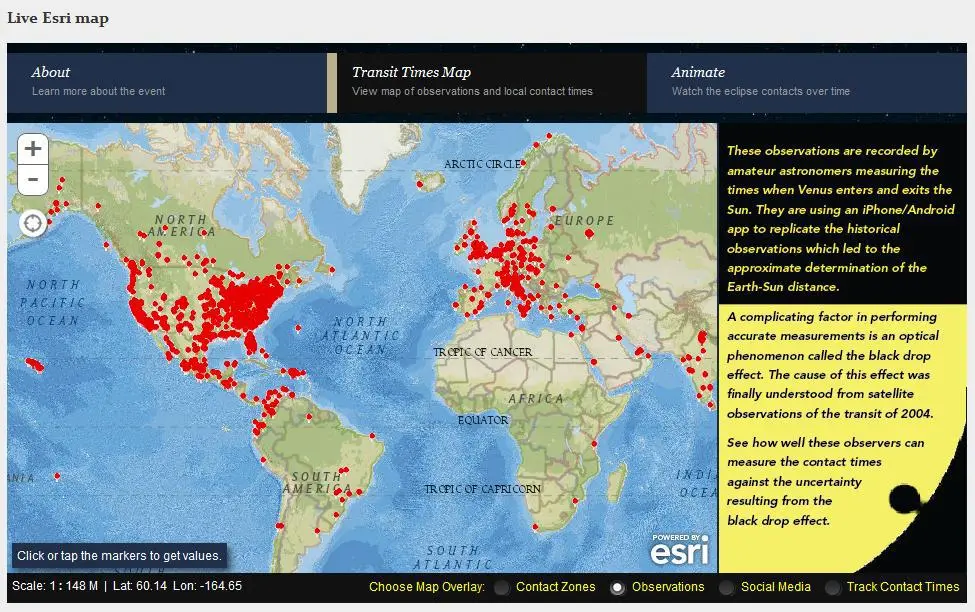
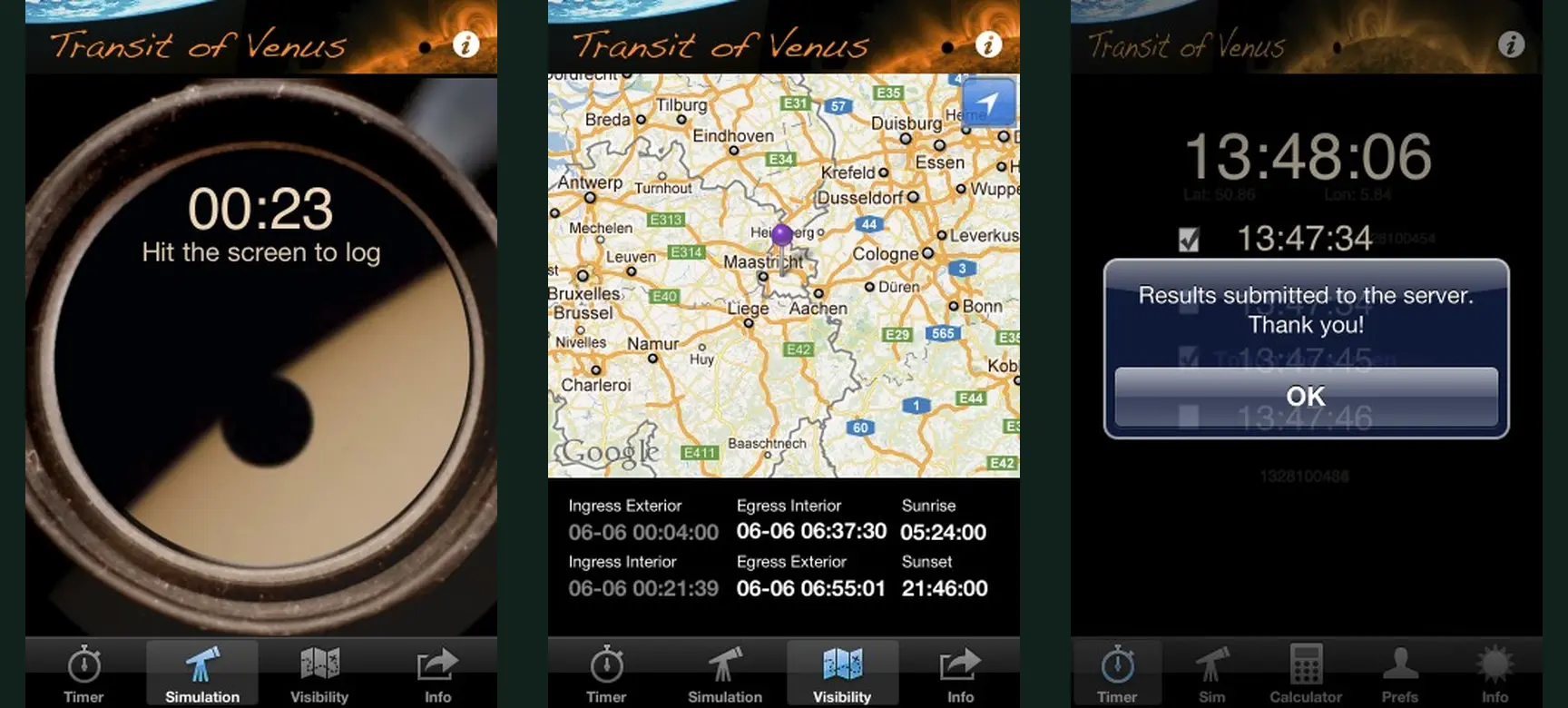
The research question was audacious and beautifully clear: could that experiment itself be crowdsourced? Pocket Science created the app for Astronomers Without Borders, turning the historic method into an action anyone in the right place could understand: showing local contact times, letting people practise with a simulation, guiding the timing and submitting observations to the worldwide attempt. The established astronomical unit supplied the method and context; the worldwide crowd was the experiment.
It did not feel like data entry
The transit was already extraordinary. The job of the app was to preserve that feeling while making the scientific action clear. Participants could see when the event would happen where they stood, rehearse the task before the sky changed and place their own timing on a global map.
That combination created momentum. News outlets around the world covered the app. Schools, amateur astronomers and curious members of the public joined. The result was not only a large download count; it was a shared scientific event.
The lesson we carried forward
Software alone did not create the response. The rare event, scientific purpose, visual experience, timing, outreach and immediate public reward worked as one. Transit of Venus established the approach Pocket Science still uses in 2026:
- Begin with wonder
Find the part of the science that gives people a genuine reason to care. - Make the action unmistakable
Translate a method into a task participants can understand and practise. - Return something meaningful
Show people where they are in the event and what their contribution joins. - Design the launch with the product
Outreach, press, onboarding and support are part of participation—not work to add after release.
Independent record
Contemporary and later references
- SciStarter: Transit of Venus App
- Los Angeles Times: Transit of Venus mania heats up with smartphone app
- TEDxEutropolis 2013: Citizen Science
The historical source archive contains differing counts for the exact number of scientifically usable records. Pocket Science therefore reports the robust scale—130,000+ downloads and tens of thousands of submissions—rather than presenting one disputed total as exact.
Why it matters now
Transit of Venus was an event app; the next transit will not happen in our lifetimes. Its value in 2026 is not that the old app should be revived. It is evidence that a small team can make a profound scientific method understandable and executable by a worldwide crowd—and test whether crowd science can work at extraordinary scale.
Everything that followed added another layer: calibrated phone cameras, optical instruments, self-hosted data services, community support, machine learning and long-term operation. The original lesson remains unchanged. If people are invited into something meaningful, they can do extraordinary science together.