iSPEX2: professional water radiometry on a smartphone
A portable spectropolarimeter for researchers measuring above-water remote-sensing reflectance—benchmarked in open campaigns alongside high-end ocean-colour radiometry.
Current positioning
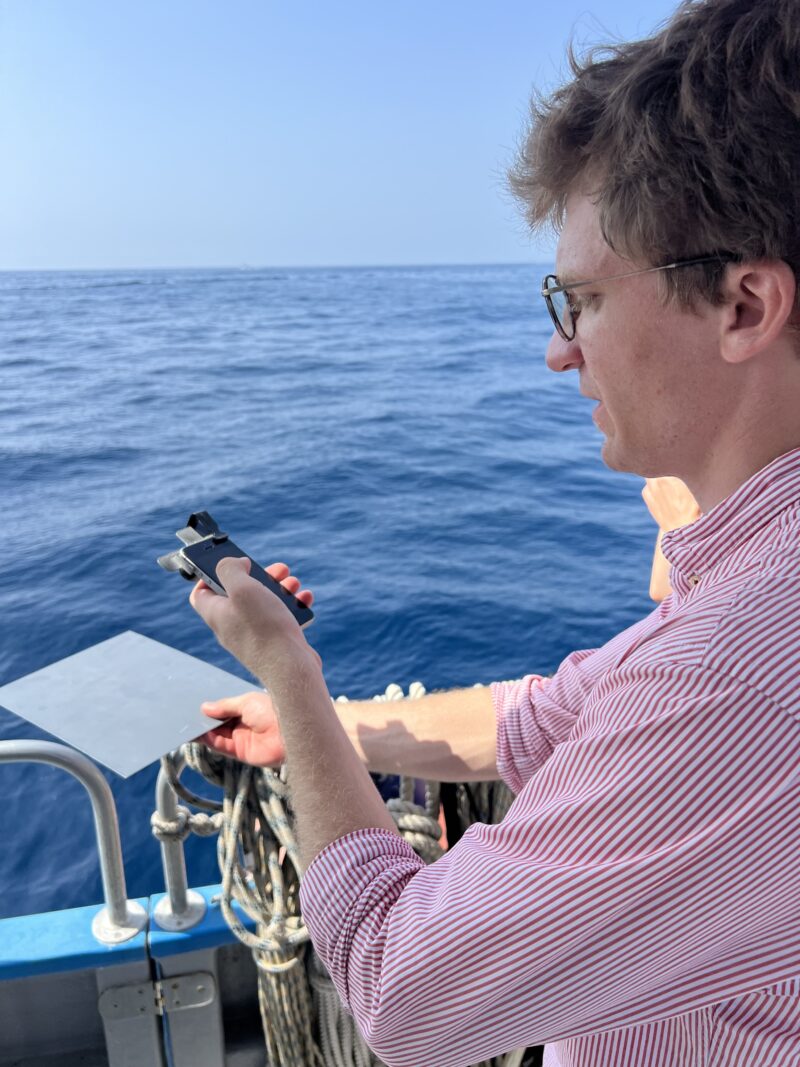
iSPEX2 is a professional research sensor, not currently a citizen-science app or project. It gives researchers a portable measurement route built around a phone. The citizen-science story below belongs to iSPEX1 and explains the instrument lineage and longer-term potential; it does not describe iSPEX2’s present deployment.
The idea that started it
Most citizen science asks people to report, photograph or classify. iSPEX went further: a small optical instrument and a supporting app turned a smartphone into part of the measurement itself. The original iSPEX campaign put atmospheric aerosol observations into citizens’ hands at remarkable scale.
That is the philosophy at the heart of Pocket Science. A phone can be more than a screen between a person and a database. Combined with the right instrument, method and guidance, it can give people a new scientific sense.
iSPEX1: a nationwide air-quality observatory
Pocket Science built iSPEX1 for Leiden University and subsequently took over iSPEX development. Leiden University led the scientific citizen-science campaign; Pocket Science carried the smartphone implementation and the later instrument, app, processing, backend and deployment work forward.
In 2013, 10,000 iSPEX instruments were produced and distributed across the Netherlands. Thousands of citizens measured atmospheric aerosols with their phones. Their observations were combined into a national air-pollution map that agreed with professional ground and satellite measurements.
Where the citizen observations were dense, the map revealed kilometre-scale local structure that the MODIS satellite comparison did not show. That was the breakthrough: a distributed public instrument network could complement professional monitoring with measurements at places and times conventional systems miss.
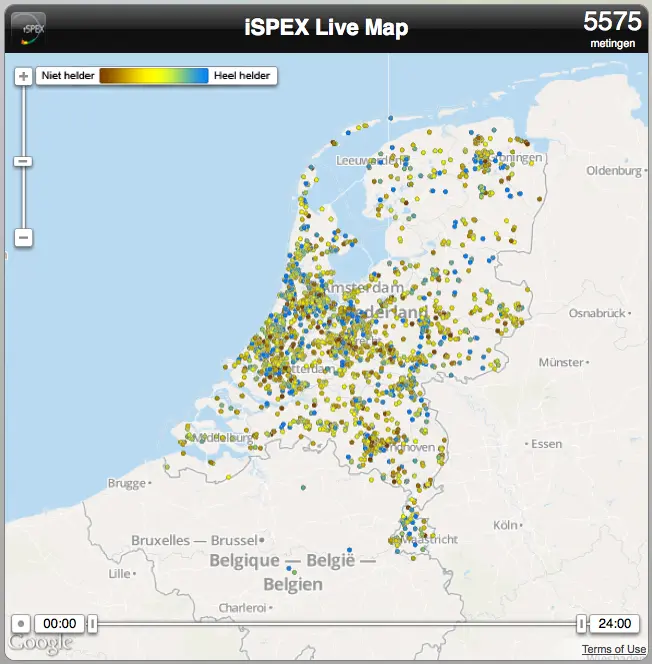
This was one of the first successful citizen-science projects at this scale in the Netherlands. It established that citizens could do more than report air quality: with the right instrument and method, they could measure it.
Independent record
A decisive milestone: deriving above-water Rrs
Prof Stefan Simis and Dr Tom Jordan at Plymouth Marine Laboratory successfully derived above-water remote-sensing reflectance (Rrs) with iSPEX2 during multiple professional campaigns in 2025. Pocket Science spent many hours supporting the app, instrument and processing work behind those campaigns.
The campaign method compares iSPEX2 observations with professional reference radiometry used in ocean-colour work. The public record includes Water Insight WISP-3 reference data, selected PML So-Rad matchups and a protocol that identifies So-Rad with TriOS-RAMSES radiometers as an established reference system. This supports iSPEX2 as a portable professional route for the tested Rrs workflow, while remaining narrower than universal hardware equivalence.
Active, wanted and still moving
Many iSPEX2 units were distributed to research groups at the end of 2025, and the complete batch is now in use. The open research archive shows continuing campaign activity across international groups in 2025 and 2026. Interest did not disappear when one project ended; it kept moving from one scientific team and field setting to the next.
There are currently no units left to order. That is not the end of iSPEX. It means the research batch was fully distributed and a new production phase needs funding.
The vision: one instrument for water and air
Imagine 10,000 people measuring water quality with a compact scientific instrument in their pocket—not merely reporting what they see, but contributing through a validated method. Today, iSPEX2 has proven its above-water Rrs method. The original iSPEX established the air-quality lineage; implementing and validating the iSPEX2 air method would bring the two ambitions into one instrument concept.
If that work succeeds, the same instrument concept could support citizen observation of water and air. A distributed network of people could collect environmental measurements across places and times that conventional instruments cannot easily cover. That is the crazy, powerful idea worth pursuing.
Open science is part of the proof
The iSPEX2 project is open on OSF. The registered study, measurement methods, app guidance, reference data, raw campaign data and processing results can be inspected and built upon. Pocket Science also maintains a complete, hash-verified preservation mirror of the public record so it does not depend on one external platform or funding cycle.
The public record also keeps the boundary honest: water radiometry is the validated achievement; iSPEX2 air quality remains future work.
A vision we continue to believe in
The iSPEX journey taught us that scientific potential often outlives a four-year project. Researchers move on and funding cycles end, while the instrument, knowledge, demand and public promise remain. Pocket Science has preserved that continuity because we believe the opportunity is worth developing.
Realising the vision at citizen scale now requires a properly funded productisation phase: production engineering, consistent calibration, software, support and wider deployment. iSPEX2 is an active research instrument, not yet a consumer-ready product.
Imagine another 10,000 people measuring water quality with iSPEX—and, one day, using the same instrument concept to observe air.
That is the potential the Pocket Science team believes in. PML’s successful validation strengthened the scientific foundation; the next step is finding the partners and investment that can bring the vision to citizen scale.
The instrument, app and science are one system
iSPEX is not powerful because it has an app. It is powerful because the optics, physical alignment, camera behaviour, calibration, guided acquisition, metadata, signal processing, quality control, backend and participant experience work together. Every part influences the scientific result.
Leiden University is the scientific origin and led the original air-quality campaign. Pocket Science built iSPEX1 for Leiden, took over iSPEX development and carried the smartphone implementation—the “i” in iSPEX—through apps, instrument development, processing, backend, distribution and international deployment. Plymouth Marine Laboratory later delivered the successful iSPEX2 water-radiometry validation. That integrated instrument-to-community chain is one of Pocket Science’s deepest capabilities.
Explore the evidence
- iSPEX2 research, publications and validation
- Hash-verified preservation mirror of the complete public OSF project
- Original iSPEX2 research programme on OSF
- Registered aquatic-reflectance validation study
- A universal smartphone add-on for portable spectroscopy and polarimetry: iSPEX 2
- Standardized spectral and radiometric calibration of consumer cameras
- Scientific iSPEX website
- Current research status and support
A shared opportunity
Pocket Science is actively looking for research, funding, investment and production partners who share the ambition of a serious environmental instrument in citizens’ hands. Start a conversation about iSPEX2.