iSPEX2 research, publications and validation
iSPEX2 rests on a published smartphone-calibration and spectropolarimetry lineage, an openly preregistered aquatic-reflectance study and continuing international field research.
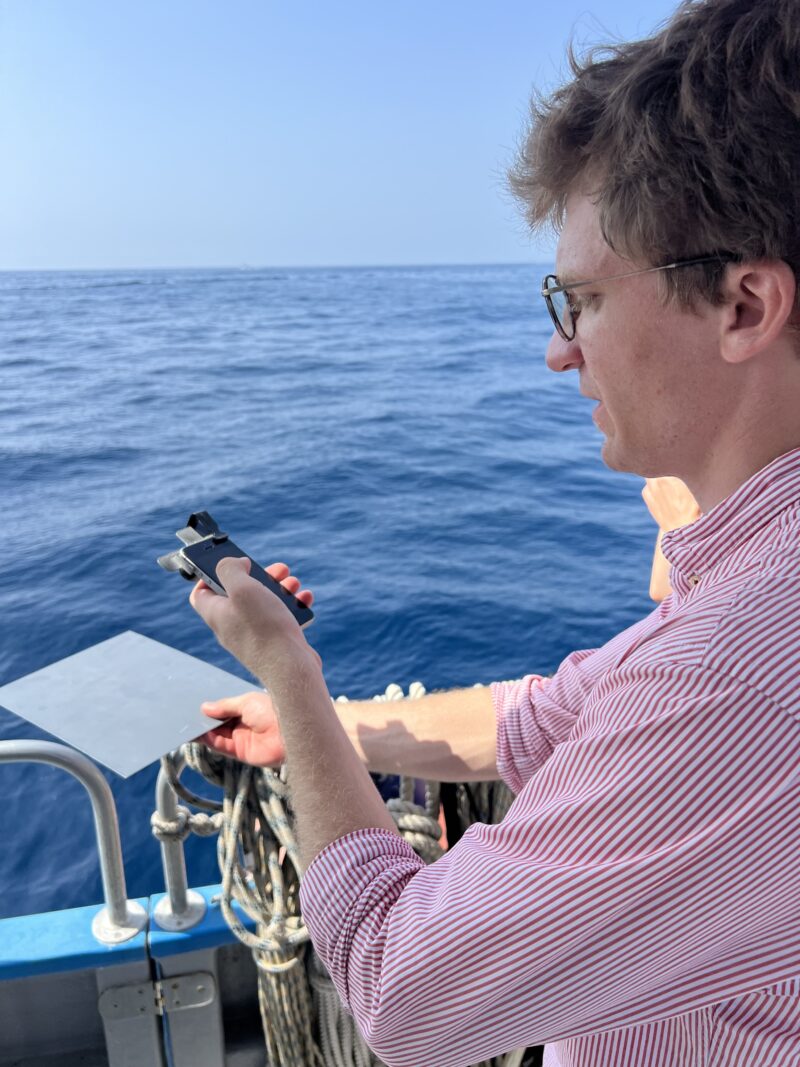
What iSPEX2 is
iSPEX2 is a modular smartphone spectropolarimeter developed for portable spectroscopy and polarimetry. Its optical attachment spreads and modulates light onto the phone camera; calibration and processing are therefore part of the instrument, not optional extras. Published applications proposed for the platform include atmospheric aerosol observation and surface-water reflectance.
The present validated achievement is narrower and more useful than a generic “water sensor” claim: Plymouth Marine Laboratory successfully derived above-water remote-sensing reflectance (Rrs) with iSPEX2 during professional campaigns, with extensive Pocket Science technical support. iSPEX2 is still a research instrument. It does not directly certify drinking-water safety, detect every pollutant or provide a consumer-ready measurement of every water-quality property.
Open aquatic Rrs validation
The aquatic campaign was preregistered in September 2024. Its stated method derives water-leaving reflectance from measurements of the water, sky and a grey reference card at defined above-water geometry, then compares those observations with synchronous professional reference radiometry. The preregistration records the hypotheses, comparison thresholds and analysis questions before results were produced; those planned thresholds should not be misread as published outcomes.
The public iSPEX2 OSF project now includes measurement protocols, app guidance, device-characterisation material, reference-data folders, raw iSPEX campaign folders and a PML processing-results archive. Pocket Science has also created a local preservation mirror of the complete public project so this record does not depend on OSF’s continued operation or project funding. The archive documents research activity at PML, Savannah River/Skidaway, Venice, Mondsee, the 2026 IOCCG Summer Lecture Series and University of Maine campaigns. Folder presence documents participation and open data; it does not by itself establish equivalent performance at every site or with every phone.
What the evidence supports
- Above-water radiometry
A defined acquisition route for deriving spectral remote-sensing reflectance above natural waters. - Smartphone spectroscopy
A modular add-on that uses calibrated smartphone cameras as part of a portable spectropolarimeter. - Reference comparison
Campaign design pairs iSPEX2 observations with synchronous professional field radiometry. - Open reproducibility
Preregistration, protocols, app documentation, campaign files and processing artefacts are publicly inspectable. - Distributed research
A fully distributed research batch supports continuing work across multiple international institutions and environments. - Defined boundaries
Phone model, calibration, optics, geometry, exposure, construction and processing can all affect the result.
Compared with professional reference radiometry
The validation programme is explicitly built around synchronous comparison with high-end systems used for ocean-colour work. The preserved campaign record includes a Water Insight WISP-3 reference dataset from Venice and a PML processing archive with selected So-Rad matchups. The reference protocol describes So-Rad using TriOS-RAMSES radiometers as an established three-sensor above-water reflectance system.
The practical proposition
iSPEX2 puts the optical attachment, calibrated smartphone, grey reference, acquisition protocol and processing into a portable research workflow. PML’s successful Rrs derivation shows that the phone-based instrument can produce scientifically useful above-water reflectance for direct comparison with established professional radiometry.
Scope: this is evidence for the tested Rrs method and campaign matchups, not a blanket claim that iSPEX2 duplicates every capability, calibration certificate, spectral range or automated operating mode of WISP-3, So-Rad or TriOS-RAMSES.
Core iSPEX publications
2022 · Calibrated smartphone radiometry for water
Burggraaff, O. et al. “Accuracy and reproducibility of above-water radiometry with calibrated smartphone cameras using RAW data.” Frontiers in Remote Sensing.
Evaluates the accuracy and reproducibility of calibrated consumer-phone camera radiometry above water. This work is a scientific precursor to the iSPEX2 aquatic field-validation route.
2020 · The iSPEX2 instrument
Burggraaff, O. et al. “A universal smartphone add-on for portable spectroscopy and polarimetry: iSPEX 2.” Proceedings of SPIE 11389.
Introduces the modular instrument architecture, support for different smartphones and its connection to the SPECTACLE calibration and processing approach.
2019 · Standardising consumer-camera calibration
Burggraaff, O. et al. “Standardized spectral and radiometric calibration of consumer cameras.” Optics Express 27, 19075–19101.
Describes SPECTACLE, the calibration framework needed to turn camera output into traceable spectral and radiometric measurements.
2014 · Citizen atmospheric mapping with iSPEX1
Snik, F. et al. “Mapping atmospheric aerosols with a citizen science network of smartphone spectropolarimeters.” Geophysical Research Letters 41.
Reports the 2013 Dutch campaign in which thousands of participants used the original iSPEX to create an aerosol map that agreed with professional observations and revealed local structure where citizen measurements were dense.
From iSPEX1 to iSPEX2
The original iSPEX established that a coordinated citizen network could use smartphone spectropolarimetry at national scale: 10,000 attachments were produced and distributed for the 2013 Netherlands campaign. iSPEX2 redesigned the attachment around broader smartphone compatibility and later moved into aquatic-reflectance research.
The lineage matters, but the applications must not be conflated. Atmospheric aerosol evidence comes from iSPEX1. Air-quality acquisition and processing have not yet been implemented or validated for iSPEX2. Likewise, successful PML Rrs derivation does not establish universal unit equivalence or readiness for unrestricted public use.
Current research status
The 2025 research batch is fully distributed and no units are currently available to order. The active programme now needs a funded next phase for production engineering, consistent calibration, software, support and wider application validation. Read the current availability and support information.
Primary evidence and documentation
- Pocket Science preservation mirror of the public iSPEX2 research record
- Original OSF programme: documentation, campaign data and processing
- Preregistered aquatic-reflectance validation study
- Scientific iSPEX website
- NERC Vocabulary Server iSPEX2 instrument record
- Pocket Science iSPEX case study
- Water-quality sensors and citizen science capability
Build the next research phase
Pocket Science can support instrument-connected apps, calibration and processing workflows, field deployment, research data infrastructure and public participation around a defensible method. Discuss an iSPEX or water-observation collaboration.