Mini Secchi research, publications and projects
Mini Secchi is part of an established, open and international research lineage in participatory water-colour and clarity observation—not a standalone app or a single paper.
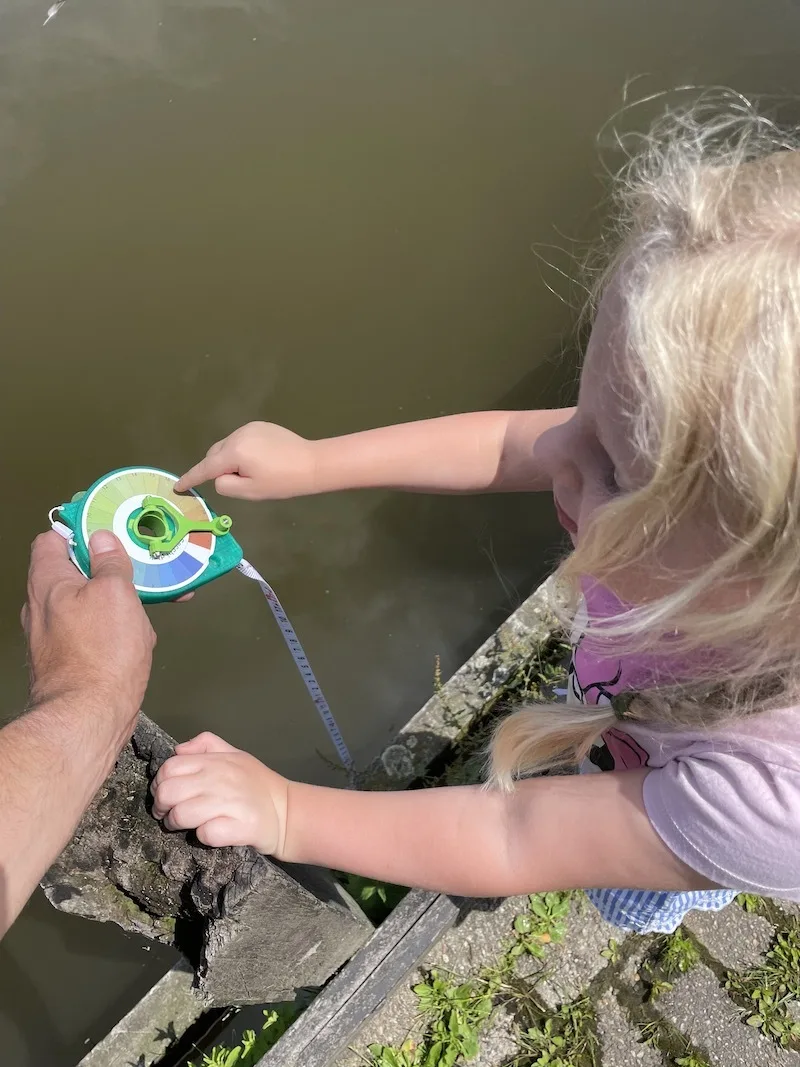
A modern participatory method with deep roots
The method combines two standardised nineteenth-century observations: Secchi depth for water clarity and the 21-colour Forel–Ule scale for natural water colour. The Mini Secchi design made the approach compact, partly 3D-printable and practical for participatory science in turbid lakes, estuaries and nearshore waters. The later Midi Secchi extended the approach to clearer water.
The 2025 methods synthesis reports 927 devices produced and distributed through international research, teaching and public-engagement activity. It documents applications including satellite-product evaluation, scientific investigation, education and public participation. Pocket Science is a co-author of that synthesis and developed the Mini Secchi participant software and supporting services in the MONOCLE lineage.
Documented programmes
The published project overview records five participatory-science programmes plus a global capacity-development network. Their methods and applications differ; Mini Secchi does not turn every observation into a general test for pollution or drinking-water safety.
| Programme | Scientific focus | Region | Reported disks |
|---|---|---|---|
| REVIVAL | Participatory water-quality observation | Lake Vembanad, Kerala, India | 100 |
| WIDGEON | Evaluation of satellite imagery | Lake Vembanad and nearshore Kerala | 50 |
| MONOCLE | Sustainable in-situ optical observation for water quality | UK, Europe and Africa; participatory deployment at Lake Tanganyika | 160 |
| POCN / SOCON | Participatory observations for evaluating satellite ocean-colour imagery | United States coasts | 100 |
| LÉMANSCOPE | Seasonal and spatial water-quality variation, satellite evaluation and public dialogue | Lake Geneva | 367 |
| NANO-DOAP | Coastal deoxygenation, ocean acidification and productivity | Global | 50 |
An additional 100 devices supported the Trevor Platt Science Foundation student network, scientific and citizen use, field campaigns, teaching and engagement. Figures are those reported in the 2025 synthesis; they are not presented as current sales or live-user counts.
What the evidence supports
- Water clarity
Secchi depth observations using a defined visual field procedure. - Water colour
Forel–Ule comparison that records natural colour on a 21-point scale. - Satellite evaluation
In-situ observations can complement and help evaluate remotely sensed water products. - Spatial and temporal coverage
Distributed participants can observe places and times that professional programmes may not cover alone. - Education and engagement
A visible physical method helps connect optics, aquatic ecology and Earth observation. - Iterative improvement
User feedback has informed stronger components, longer tapes, additional weights and new instrumented variants.
Core Mini and Midi Secchi publications
2025 · International methods and project synthesis
Brewin, R.J.W. et al. “An innovation of two established methods for monitoring water colour and clarity: participatory science using the mini- and midi-Secchi disks.” Frontiers in Environmental Science 13.
Documents the method, six principal programmes, 927 distributed devices, collected datasets, satellite comparisons, scientific applications and recommendations for future development.
2024 · Instrumented, open-source development
Brewin, R.J.W. et al. “Lab on a Secchi disk: a prototype open-source profiling package for low-cost monitoring in aquatic environments.” Limnology and Oceanography: Methods 22, 507–526.
Reports design improvements to the Mini and Midi Secchi and a sensing Secchi disk prototype integrating pressure, temperature and spectral-light measurement.
2021 · Real-time citizen monitoring
George, G. et al. “Citizen scientists contribute to real-time monitoring of lake water quality using 3D printed mini Secchi disks.” Frontiers in Water 3.
Documents citizen use of the 3D-printed method in Lake Vembanad and its role in a real-time participatory monitoring programme.
2021 · An applied estuarine study
Menon, N. et al. “Citizen science tools reveal changes in estuarine water quality following demolition of buildings.” Remote Sensing 13, 1683.
Shows the broader research use of participatory tools in the Lake Vembanad programme and connects field observations to an environmental event.
2019 · The original printable design
Brewin, R.J.W. et al. “A printable device for measuring clarity and colour in lake and nearshore waters.” Sensors 19, 936.
Introduces the compact, partly 3D-printed Mini Secchi design, manufacturing approach, field operation and initial evaluation.
Related scientific foundation and comparison
These publications are part of the surrounding evidence base. They do not all evaluate the Pocket Science app or Mini Secchi hardware directly, so they are listed separately.
- Neale et al. (2024), participatory methods for water quality and remote-sensing ground truth in Chesapeake Bay
- Bresnahan et al. (2024), high-resolution ocean-colour imagery from the SeaHawk–HawkEye CubeSat mission
- Brewin et al. (2023), historic and modern optical techniques for monitoring Atlantic phytoplankton biomass
- Ramírez et al. (2023), review of citizen-science approaches for water-quality measurements
- Kirby et al. (2021), comparison of citizen and scientific ocean-transparency observations
- Malthus et al. (2020), evaluation of citizen-science smartphone apps for inland water-quality assessment
- Pitarch et al. (2019), optical properties of Forel–Ule water types from global satellite observations
- Ye and Sun (2022), review of the Forel–Ule Index and its water-quality applications
The complete bibliography and methodological discussion are available in the 2025 open-access synthesis.
Current development: a new Mini Secchi phase
In 2026 Pocket Science began a newly contracted rebuild and improvement of the Mini Secchi software supporting the University of Exeter and the US SOCON collaboration. The work continues an iterative approach already visible in the published record: field feedback, scientific requirements, participant guidance and data infrastructure evolve together.
SOCON—Sustained Ocean Color Observations using Nanosatellites—connects high-resolution satellite ocean-colour observation with supporting field evidence. The Participatory Ocean Color Network (POCN) uses Mini Secchi observations with participants along US coasts.
Primary project and method resources
- European Commission record for Horizon 2020 MONOCLE
- NASA overview of SOCON
- Smart Coasts Collaboratory: Participatory Ocean Color Network
- Open physical Mini and Midi Secchi designs and disk information
- Pocket Science Mini Secchi observation map
- Current Mini Secchi web application
Plan a participatory water-monitoring programme
Pocket Science can provide the participant applications, method guidance, contextual data, project configuration, secure infrastructure, research access and long-term operation around an agreed scientific protocol. Discuss a water research project or explore the wider citizen science water-quality capability.