Mini Secchi: a published field method made accessible
A physical water-colour and clarity method connected to clear participant guidance, mobile and web apps and research data infrastructure.
The research challenge
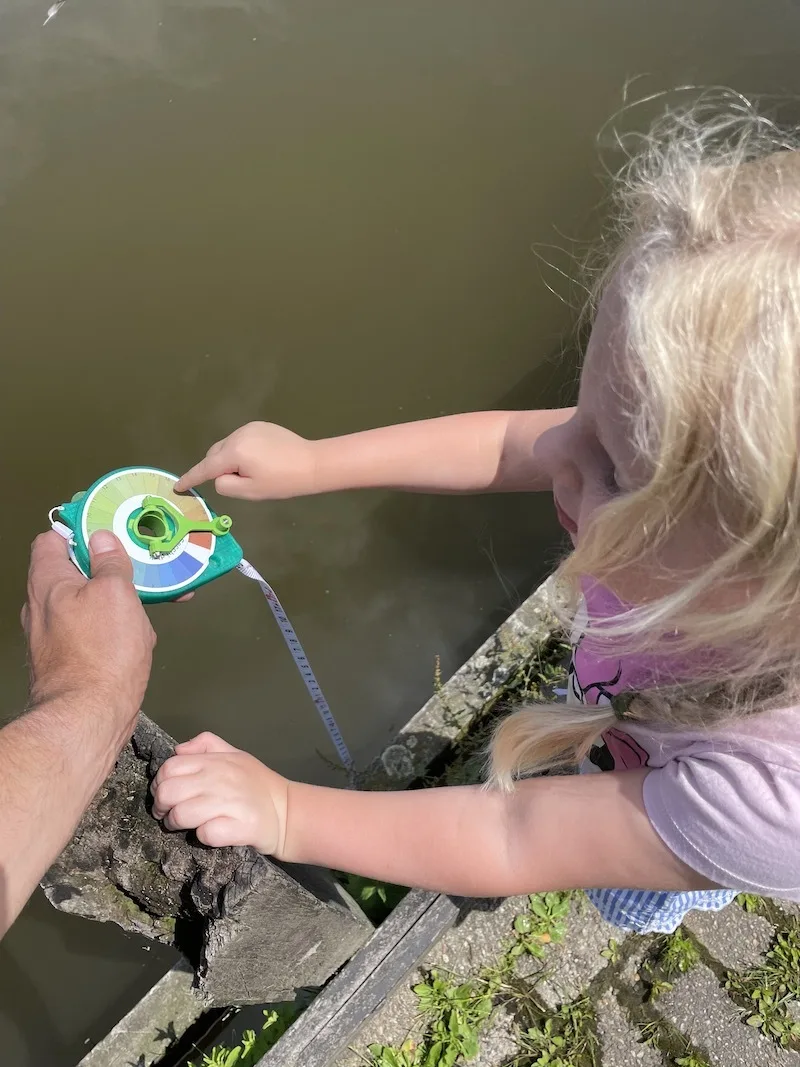
Water colour and transparency are valuable observations, but a field measurement must follow a comprehensible and repeatable procedure. Mini Secchi combines a compact physical disk with an application that guides the participant, records context and connects observations to a wider data service.
What Pocket Science contributed
Pocket Science developed the participant-facing mobile technology and supporting services in the Horizon 2020 MONOCLE lineage, working with research and field partners on portable water observation. The system spans iOS, Android and the web.
The physical disk alone is not the product, and the app alone is not the method. The participant uses the disk at the water, interprets visibility and colour under field conditions and records the result consistently. Guidance, terminology, contextual fields, quality controls and synchronisation all influence the usefulness of the observation.
A substantial published record
Mini Secchi is supported by a multi-paper evidence base, not a single reference. It begins with the 2019 printable device and includes real-time citizen monitoring at Lake Vembanad, an applied estuarine study, the 2024 open-source “Lab on a Secchi disk” prototype and the 2025 international methods and programme synthesis.
The 2025 synthesis documents 927 Mini and Midi Secchi disks across six principal programmes: REVIVAL, WIDGEON, MONOCLE, POCN/SOCON, LÉMANSCOPE and NANO-DOAP. Applications include participatory water observation, scientific investigation, education and evaluation of satellite water products.
Research gateway
A new phase in 2026
Pocket Science signed a new contract with the University of Exeter and the US SOCON collaboration to rebuild and improve Mini Secchi. The latest app update adds offline syncing, an updated map, multilingual support and bug fixes. The work carries participant feedback, field requirements and an established scientific method into a renewed software and data workflow.
What the method does—and does not do
Mini Secchi records defined visual observations of water clarity and Forel–Ule water colour. It is not a universal pollution detector or a drinking-water safety test. The research meaning comes from the protocol, deployment, context and analysis.
The transferable capability
Mini Secchi demonstrates how Pocket Science connects a physical field object, guided participant workflow, environmental context and global data service. That pattern is relevant to citizen science water monitoring, environmental education and other distributed sensing programmes.
If your research requires a participant-facing method, scientific sensing or long-lived data infrastructure, tell us what people should be able to measure.